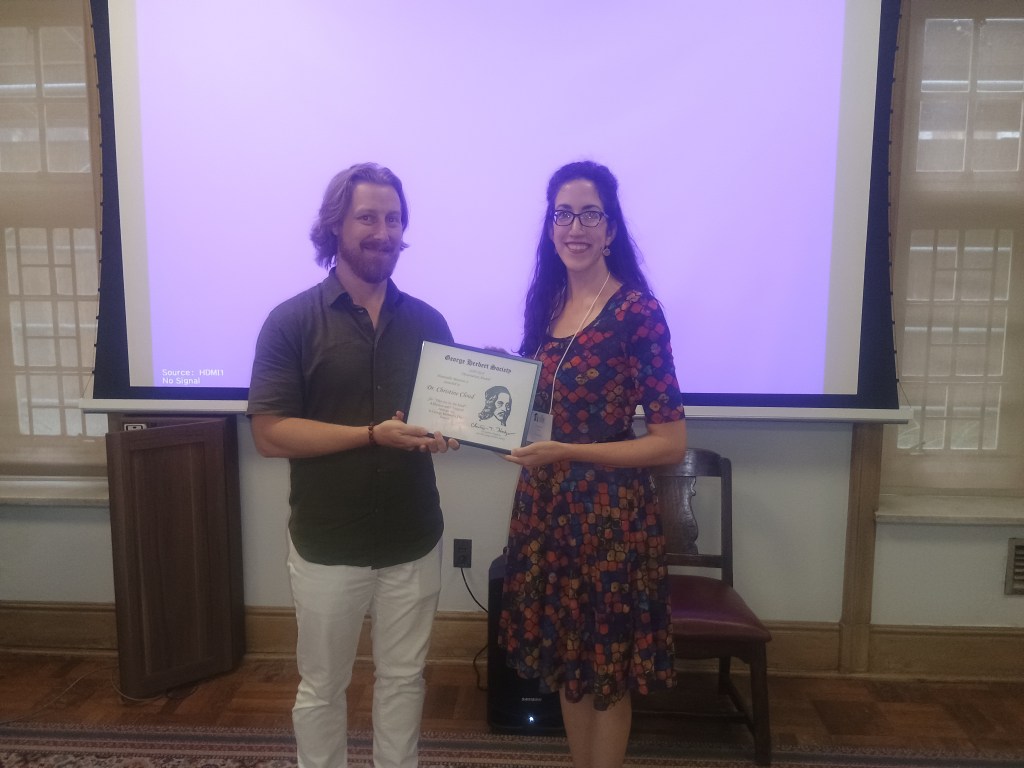
Citation for Christine Cloud as the Honourable Mention Award Winner for 2020-2024
Once again the panel evaluating submissions for the Chauncey Wood Dissertation Award of the George Herbert Society has decided to make an Honourable Mention Award for a dissertation we felt was very much worth acknowledging. The Honourable Mention Award for 2020-2024 goes to Christine Cloud, for “‘Take me by the hand’: Affliction and Liturgical Participation in George Herbert’s The Temple,” completed in 2021 at Baylor University under the direction of Phillip J. Donnelly. This thesis examines the unity of The Temple via a close analysis of two clusters of related poems: the five titled “Affliction” and the numerous texts whose titles clearly identify them as liturgical, directly related to the feast and fast days on the church calendar. Cloud maps intricate patterns of interaction within and also across these groups that convey Herbert’s deep understanding of a theology of Christian suffering, and not only represent but enact a pilgrimage and powerfully engage the reader in the linked experiences of affliction and assurance.
The evaluating committee was impressed by the subtlety, ambition, and persuasiveness of Cloud’s presentation of the complex connectedness and cumulative power of a substantial selection of Herbert’s key poems. One committee member noted that “There is much in this dissertation that I like: the writing is clear, she is very knowledgeable about Herbert, and she comments thoughtfully and intelligently about liturgical, formal, and structural elements, all the while never losing sight of the experiential power of the poems amplified when they are taken together.” Another member praised the work as “a well-written and judicious dissertation, one that takes some risks with original thinking. The command of criticism is crisp but very full and develops on views established in the field . . . Cloud’s elaborations [on the intricate structure of The Temple] seem to me bold inventive thinking worthy of further discussion in the field.” Some of the individual chapters were praised in particular — notably a detailed examination of the “Whitsunday” sequence, revolving around a poem not usually singled out for attention and appreciation — but the committee agreed in praising her work as, like the volume she so deftly interprets, an intricately arranged and connected whole. One committee member’s concluding comment nicely captures the judgment of the entire committee: Cloud’s thesis is “impressive in its thoroughness, clarity of argument, and agile use of the vast amount of Herbert criticism. I can imagine many interested readers of it, and regret only that Eliot is not around to be one of them.”
Congratulations from the Committee: Sidney Gottlieb (Sacred Heart University), Chair; Jonathan F. S. Post (University of California at Los Angeles); Gordon Teskey (Harvard University); Helen Wilcox (Bangor University, Wales)
$250 USD Prize; $250 Travel Bursary; Waiver of Toronto Conference Registration Fee
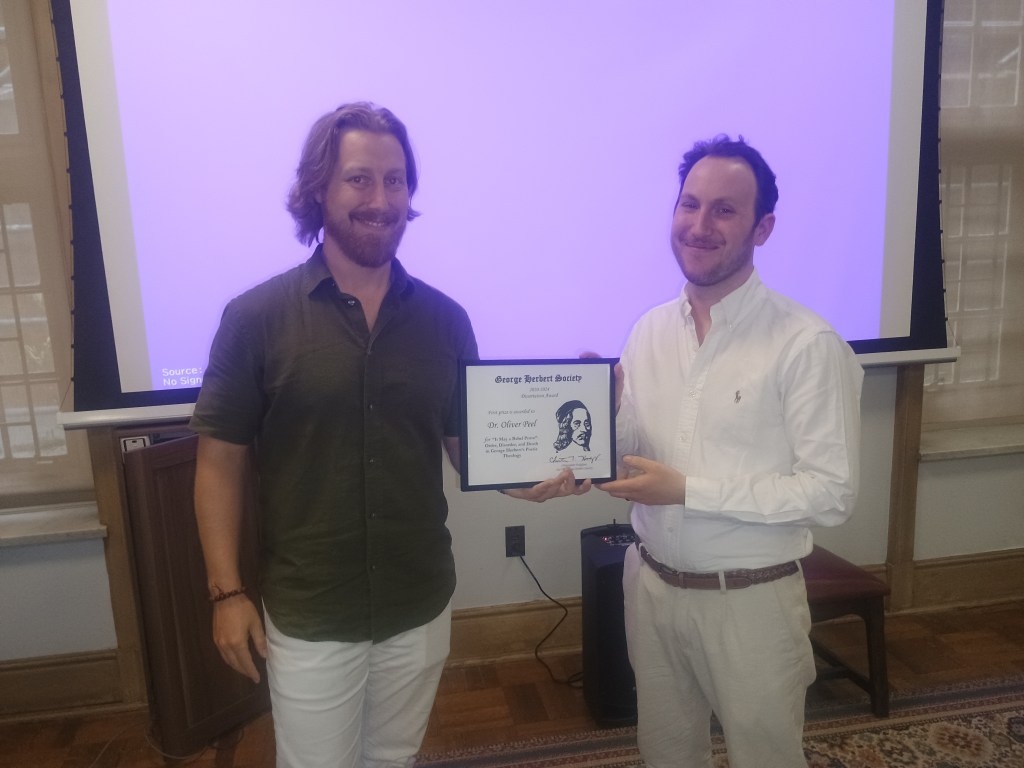
Citation for Oliver Peel as the Chauncey Wood Dissertation Award Winner for 2020-2024
Oliver David Peel: “‘It May a Babel Prove’: Order, Disorder, and Death on George Herbert’s Poetic Theology” Kings College, London, 2024. Director: Susannah Ticciati
The panel of judges who evaluated all the dissertations submitted for consideration during the current award period were unanimous in their high praise of Peel’s thesis on several levels. It is framed as a work of scholarship aimed at expanding on what has long been recognized as Herbert’s knowledge of and multi-layered debt to Augustine — a subject, by the way, that was of particular interest to the scholar after whom this award is named. Chauncey Wood’s numerous commentaries on the relevance of Augustine to a serious study of Herbert provide a solid foundation for Peel’s, in the words of one of the committee members, “knowledgeable and exhaustive” elaboration of how Augustine’s extended discussions of various kinds of order and disorder figure in Herbert’s theology and also in the experiences represented and anatomized in his poems. And Peel examines in detail how Augustine’s recurrent attention to the subject of death — not only of course as a central personal and collective experience (and worry) in life but also as a subject perennially foregrounded in theology, is echoed throughout The Temple. One committee member praised Peel’s scholarship as “admirable,” and another commended its “very carefully and clearly constructed argument.” But the committee also noted how successfully this thesis pursues his intention to focus on artistry as well as theology. What Peel persuasively identifies as Augustinian “radical provisionality” and “constant negotiations” are written into The Temple structurally and stylistically, and a key strength of his thesis is his skill as a close reader. As one committee member noted, “Peel’s comments on lyric narrativity are a real highlight in the dissertation, and throughout he shows a real sensitivity to Herbert’s poetic form.” It is fitting that this year’s Chauncey Wood Dissertation Award goes to an accomplished, learned, and far-ranging thesis that the selection committee concurred is “a potentially major interpretive contribution” to the understanding and appreciation of Herbert.
Warmest congratulations from the Committee: Sidney Gottlieb (Sacred Heart University), Chair; Jonathan F. S. Post (University of California at Los Angeles); Gordon Teskey (Harvard University); Helen Wilcox (Bangor University, Wales)
$600 USD Prize; $500 Travel Bursary; Waiver of Conference Registration Fee
 georgeherbertsociety.org